

Cart 0
Table of Contents
What Was the Curetes Dance?
The Curetes Dance is one of those elements of Cretan mythology that feels more like something lived than something simply told. It is usually described as a ritual performed by the Curetes — armed figures who moved rhythmically, striking shields and weapons to produce a loud, almost overwhelming sound.
At first glance, it looks like a kind of war dance. But that description alone doesn’t quite capture it.
The Curetes Dance seems to sit somewhere between performance and ritual. It carries movement, sound, and intention all at once. Not just action, but meaning behind the action.
Most of what we know comes from later Greek writers, yet the atmosphere of the ritual suggests something older. Something that likely belongs to the deeper religious landscape of Crete, long before mythology was written down in a structured way.
The Curetes Dance and the Birth of Zeus
The story most often linked to the Curetes Dance takes us to the birth of Zeus.
According to myth, Rhea gave birth to Zeus in Crete, trying to hide him from Cronus. The fear was simple — if Cronus heard the child, he would find him.
So the Curetes were placed outside the cave.
When the baby cried, they began to move. They struck their shields, clashed their weapons, and created a constant rhythm that filled the space. The sound covered everything else.
In that moment, the Curetes Dance becomes more than movement. It becomes protection.
There is something almost instinctive in that image. Not a quiet guarding, but a loud, physical one. The kind that pushes danger away rather than waiting for it.
And at the same time, something larger is happening. The survival of Zeus is not just about one child. It sets the stage for the shift from Titans to Olympians. The dance, in a way, participates in that transition.
Between Ritual and Reality
Outside the myth, the Curetes Dance may reflect real practices.
Minoan Crete was not a silent society. Archaeological findings show a culture where movement, music, and gathering played an important role. Ritual seems to have been something experienced physically, not just believed.
Even without direct evidence of this exact dance, the idea of armed, rhythmic movement is not unusual in the ancient Mediterranean. Similar practices appear elsewhere, often tied to protection, identity, or transition.
So it is possible that what later became the Curetes Dance began as something more grounded. A ritual that used sound and movement to mark important moments — perhaps linked to birth, protection, or community.
The myth may simply preserve an echo of that.
Who the Curetes Really Were
The Curetes themselves are not easy to define.
They are described as warriors, but that does not fully explain their role. They do not fight in the story. They guard, but in a very specific way.
Their identity seems split. Part warrior, part ritual figure.
In some traditions, they resemble priest-like groups — individuals who perform actions with symbolic meaning rather than direct purpose. Their connection to caves strengthens this idea. In Minoan belief, caves were not just physical spaces. They were places of transformation, of presence, of something beyond everyday life.
By dancing at the entrance of such a space, the Curetes are not just protecting Zeus. They are participating in something sacred.
The Meaning Behind the Movement
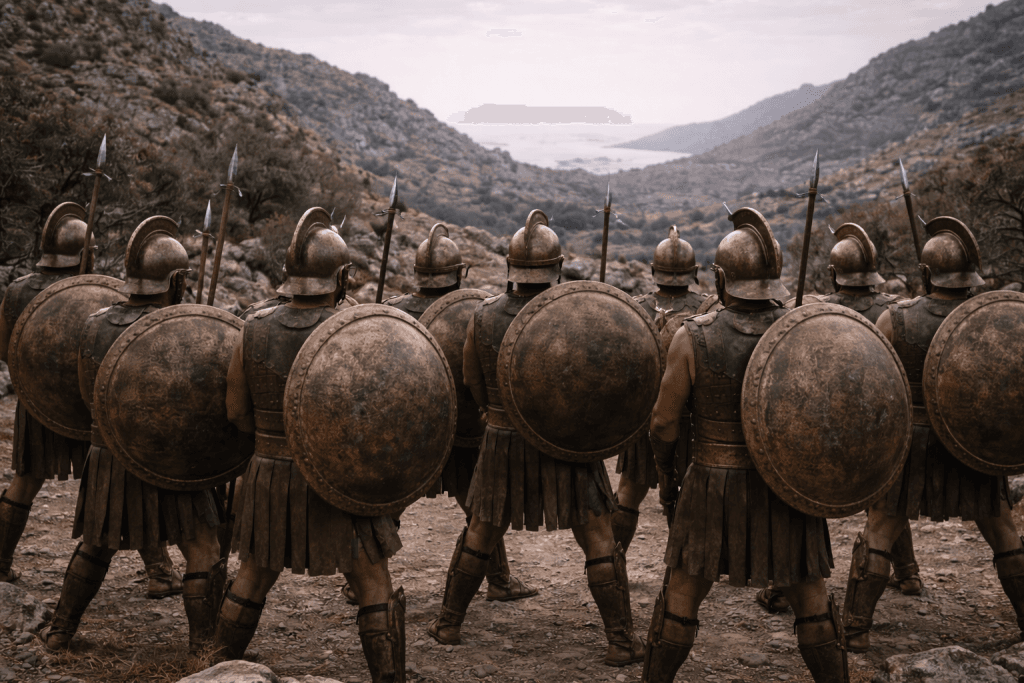
The Curetes Dance works on more than one level.
It clearly represents protection. The noise, the movement, the repetition — everything is directed toward keeping something safe.
But there is also a sense of transition. Zeus surviving means a change in order. The dance happens at that exact moment, almost as if it marks the shift.
There is also an element of control. The movement is intense, even aggressive, yet it is not chaotic. It is structured, repeated, deliberate.
That combination is important. It suggests that the dance transforms raw force into something purposeful.
Not violence, but controlled power.
A Tradition That Didn’t Disappear
Even as Greek mythology evolved, the idea behind the Curetes Dance did not vanish.
Later traditions include similar armed dances, like the Pyrrhic dance, which also combines rhythm, movement, and weapon imagery. These echoes suggest that the original concept continued to exist, even if its meaning shifted.
Over time, the Curetes remained part of Crete’s mythological identity. Not as central figures, but as something remembered.
And perhaps that is what makes the Curetes Dance interesting.
It does not feel like a finished story. It feels like something that was adapted, retold, reshaped — but never fully replaced.
Why It Still Feels Relevant
The Curetes Dance offers a different way of looking at mythology.
Instead of focusing only on gods and heroes, it draws attention to action, to ritual, to the space between belief and practice.
It reminds us that ancient religion was not just about stories. It was something people did. Something they heard, saw, and experienced together.
And in that sense, the image of armed figures moving in rhythm outside a cave is not just symbolic.
It feels real enough to have happened in some form.