
Cart 0
Table of Contents
Who Was Daedalus in Greek Mythology?
Daedalus is often described as a master craftsman, but that feels almost too simple for what he represents. In Greek mythology, he stands somewhere between artist, engineer, and problem-solver — a figure whose ideas move faster than the limits around him.
He is said to have come from Athens, where his skill quickly drew attention. Stories describe statues so lifelike they seemed ready to move, and tools that went beyond anything others could create. But alongside talent comes tension. In one early myth, Daedalus pushes his nephew Talos from the Acropolis, fearing he might surpass him. The boy survives, but Daedalus is forced into exile.
Arrival in Crete and King Minos
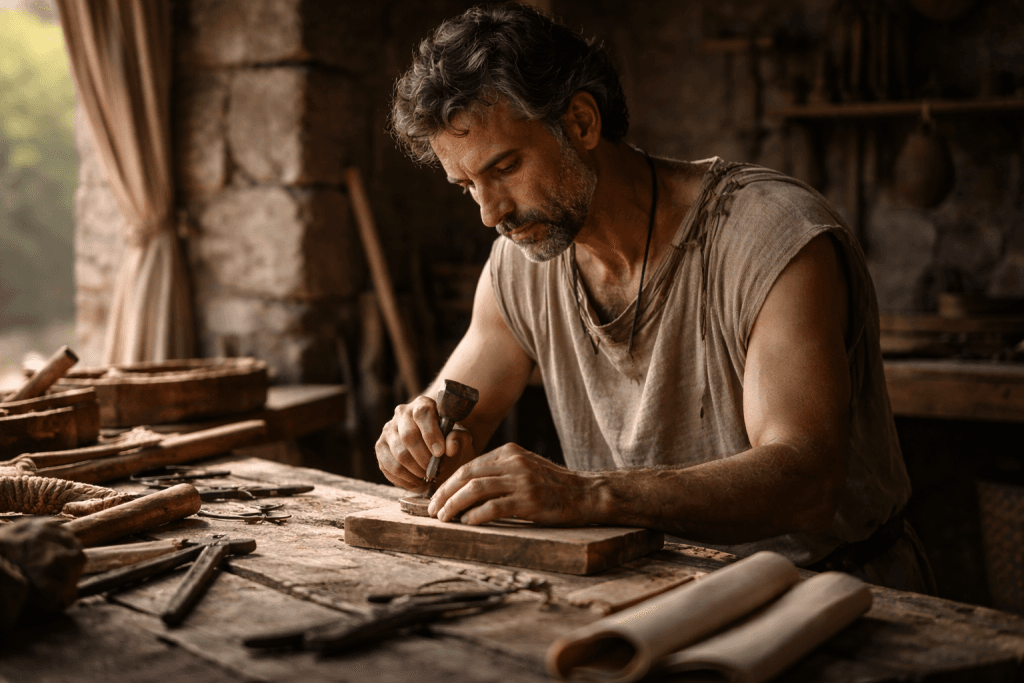
When Daedalus arrives in Crete, he enters a completely different world. At the court of King Minos, his abilities are not questioned — they are immediately used.
Minos recognizes what Daedalus can do. More importantly, he understands how useful that can be.
This relationship is not unusual in mythology. Intelligence often finds itself working for power. At first, the arrangement seems stable. Daedalus creates, Minos commands. But beneath that balance, there is already a sense that things will not remain controlled for long.
The Labyrinth of Knossos
The most famous creation linked to Daedalus is, of course, the Labyrinth.
Minos needed a way to contain the Minotaur — not just hide it, but ensure it could never escape. The solution was not a prison in the usual sense, but something far more complex. A structure designed to confuse, disorient, and trap anyone who entered.
The Labyrinth is often imagined as a maze, but in myth it feels more unsettling than that. It is not just difficult to navigate. It is deliberately disorienting.
At its center, the Minotaur.
What makes this creation interesting is not only its design, but what it represents. It turns architecture into control. Space itself becomes a tool of power.
Some modern interpretations even connect the idea of the Labyrinth to the actual layout of Knossos. The palace, with its layered rooms, corridors, and shifting levels, could easily feel overwhelming to someone unfamiliar with it. Whether or not that link is real, the association has stayed strong.
Ariadne, Theseus, and a Quiet Betrayal
The story does not stop with the Labyrinth.
When Theseus arrives to face the Minotaur, the problem is not entering the structure, but getting out. This is where Daedalus appears again, though not openly.
Through Ariadne, he offers a solution. A thread.
It is a simple idea, almost surprisingly so compared to the complexity of the Labyrinth itself. But that simplicity is exactly what makes it effective. Theseus follows the thread back and escapes.
In doing so, Daedalus crosses a line.
He helps undo the very structure he created. Not directly, but enough to break the system Minos depended on.
And Minos notices.
The Escape and the Flight of Icarus
The reaction is immediate. Daedalus is imprisoned, along with his son Icarus.
What follows is one of the most recognizable moments in Greek mythology, but it begins quietly. There is no dramatic confrontation, no battle. Just a problem that needs solving.
So Daedalus builds again.
This time, not walls or corridors, but wings. Feathers held together with wax, carefully assembled to make something impossible seem workable.
Before they leave, he gives Icarus clear instructions. Stay within limits. Not too low, not too high.
For a while, it works.
Then it doesn’t.
Icarus flies higher. The wax softens, the structure fails, and he falls into the sea. The moment is brief, but it changes everything. For all his skill, Daedalus cannot control that outcome.
It is one of the rare times where invention meets something it cannot manage.
What Daedalus Represents
Daedalus is not a hero in the traditional sense. He does not win battles or rule kingdoms. What defines him is something quieter, but just as powerful.
He creates.
And his creations shape events around him.
The Labyrinth traps, but also leads to escape. The wings save, but also lead to loss. Nothing he builds is neutral. Every invention carries consequences.
That is why his story feels different from others in Greek mythology. It is not only about action. It is about thought, intention, and what happens when ideas move beyond control.
A Figure Between Control and Freedom
Within the wider mythological world of Knossos, Daedalus connects multiple stories without ever fully belonging to one. He is part of the Minotaur myth, part of Theseus’ journey, part of Icarus’ fall.
But he is also slightly outside all of them.
He serves power, then resists it. He builds structures, then escapes them. He solves problems, but cannot prevent their consequences.
That tension is what defines him.
And perhaps that is why the image of Daedalus endures. Not just as a brilliant craftsman, but as a reminder that intelligence, no matter how advanced, does not always guarantee control.
Sometimes, it simply changes the shape of the outcome.