

Cart 0
Table of Contents
What Is the Myth of Icarus?
The Myth of Icarus doesn’t begin in the sky. It begins with a problem. A man who was too clever. A king who trusted him… and then didn’t. And a place you couldn’t leave. Icarus himself is almost secondary at first. The story really starts with his father, Daedalus — the kind of figure who solves impossible things. The kind of mind rulers want close… until they don’t.
By the time we reach Icarus, everything is already set. They are trapped in Crete. Escape is no longer a question of strength or negotiation.
Only invention is left.
Why They Couldn’t Leave
Crete, in this story, isn’t just an island. It’s a controlled space.
Daedalus had built the Labyrinth for King Minos — a structure so complex that even its creator becomes part of its consequences. When he later helps Theseus escape, the balance breaks.Minos reacts as rulers often do in myth. Not with debate, but with punishment.
So Daedalus and Icarus are confined. Maybe in a tower. Maybe within the Labyrinth itself. The exact version changes, but the result is always the same.
They cannot leave.
Not by land.
Not by sea.
And that’s where the idea appears.
The Decision to Fly
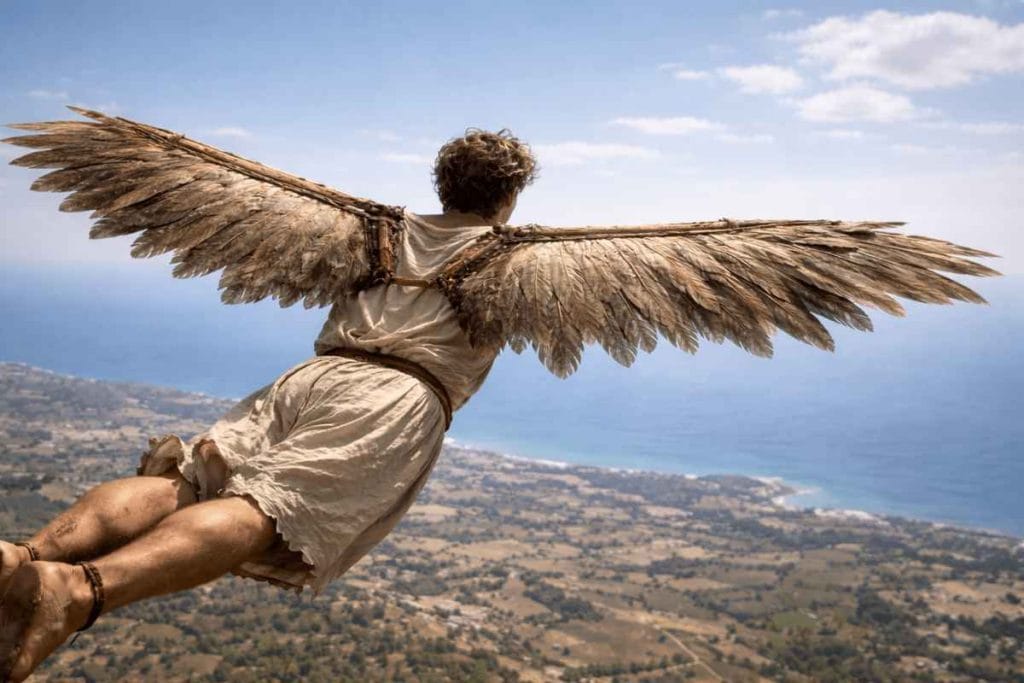
There’s something almost quiet about this moment.
Daedalus watches birds.
It’s not dramatic. No divine intervention. Just observation. Patience. A shift in thinking.
If the usual paths are closed, you create a new one.
He gathers feathers. Small ones, larger ones. Binds them together. Uses wax to hold everything in place. It’s delicate work — not the kind that forgives mistakes.
Two pairs of wings. One for him. One for Icarus.
Before they leave, he gives instructions. Not long speeches. Just boundaries.
Don’t fly too low.
Don’t fly too high.
Stay in the middle.
That’s the entire philosophy of the myth, compressed into a few lines.
The Flight
For a moment, everything works.
They rise above the island. Above control, above confinement, above Minos himself. It’s difficult not to imagine the feeling — the sudden lightness, the silence of height, the idea that limits can be broken.
This is the part people often forget.
The escape is successful.
For a while.
The Moment It Changes
Icarus doesn’t fall immediately. That’s important.
There’s time in between. Time to feel the freedom. Time to forget the warning.
He climbs higher. Not out of calculation, but out of instinct. Curiosity. Maybe even joy.
The myth never fully condemns him for that.
But it doesn’t protect him either.
The sun does what it always does. It doesn’t act out of anger. It doesn’t notice him at all.
The wax softens.
That’s enough.
The Fall
There’s no recovery once it starts.
Feathers loosen. The structure fails. What was carefully constructed becomes fragile again.
And then, suddenly, he’s no longer flying.
The sea takes him.
It’s quiet in the myth. No dramatic speeches. No final words. Just the fall, and the absence that follows.
Daedalus continues.
That detail matters more than it seems.
What the Myth Is Really About
The Myth of Icarus is often reduced to a warning. Don’t be reckless. Don’t aim too high. But it feels more complicated than that. Because without risk, they would never have escaped. Without invention, they would still be trapped. So the story isn’t simply against ambition. It’s about balance. About knowing how far to go — and when to stop. Daedalus understands this. Icarus doesn’t. Not because he’s foolish, but because he’s human in a different way. Less controlled. More immediate.
That contrast is what gives the myth its weight.
Why It Still Feels Familiar
Even now, the story doesn’t feel distant. People still use Icarus as a reference point. Not always negatively. Sometimes almost with admiration. There’s something compelling about the attempt itself. The idea of pushing beyond limits. Of seeing how far you can go. And maybe that’s why the myth lasts. Not because of the fall. But because, for a moment, the flight was real.
A Story That Begins in Crete — and Goes Further
The Myth of Icarus is tied to Crete, to Knossos, to the wider network of stories around Minos, the Labyrinth, and Daedalus. But it doesn’t stay there. It moves beyond geography. Beyond mythology. It becomes something simpler, and harder to ignore: The tension between what we can do…
and what we should do.
And somewhere in between those two, Icarus is still flying.