
Cart 0
Table of Contents
Who Was Rhadamanthys in Greek Mythology?
Not every figure in Greek mythology is remembered for battles, monsters, or dramatic downfalls. Rhadamanthys stands out for a different reason. He is remembered for justice.
As the son of Zeus and Europa, and brother to King Minos, he belongs to one of the most powerful mythological families connected to Crete. Yet his story moves in a quieter direction. While Minos becomes tied to authority, control, and the Labyrinth, Rhadamanthys is consistently described as fair, composed, and difficult to corrupt. That contrast is important. It shows that power in mythology is not always expressed through dominance. Sometimes, it is defined by restraint.
A Different Kind of Ruler
Ancient sources often describe Rhadamanthys as a lawgiver.
Not in the abstract sense, but as someone who actively shaped how people lived and interacted. His authority did not depend on fear or force. Instead, it rested on trust — the belief that his decisions were balanced and consistent. In some traditions, he ruled parts of Crete independently. In others, he appears as an advisor within the royal structure, someone whose judgment even Minos respected.
That detail says a lot. Within a mythological world full of strong personalities and competing ambitions, Rhadamanthys represents something rare — a figure whose strength comes from clarity rather than control.
Leaving Crete Behind
Interestingly, his story does not always remain on the island. Some versions describe tension between the brothers, leading Rhadamanthys to leave Crete altogether. He is then connected with other regions of the Greek world, sometimes even linked to Boeotia. There are also traditions that place him alongside Alcmene, the mother of Heracles, later in life. These variations do not weaken his identity. If anything, they expand it. Wherever he appears, the same characteristic follows him: fairness. He is not redefined by location or circumstance. His role remains stable, even when the setting changes.
Judgment Beyond Life
The most significant transformation in his story happens after death.
Rhadamanthys becomes one of the three judges of the underworld, alongside Minos and Aeacus. In this role, he is responsible for evaluating the souls of the dead — particularly those who lived just and honorable lives.
This is not a symbolic position. It is one of the highest forms of authority in Greek mythology. What is interesting is how consistently he is portrayed. While Minos can appear strict or even severe in later traditions, Rhadamanthys remains measured. Calm. Balanced.
In some accounts, he is associated with the Elysian Fields — a place reserved for those who lived well. That connection reinforces his identity. He is not only a judge, but also a figure linked to reward and moral clarity. Justice, in his case, is not punishment-focused. It is evaluative.
What Rhadamanthys Represents
It is easy to overlook a character like Rhadamanthys in a mythology filled with dramatic figures. But that would miss the point. He represents a different model of power. Not the kind that dominates, but the kind that stabilizes. His story suggests that authority does not need spectacle. It does not require fear or excess. Instead, it can exist quietly, built on consistency and judgment. In symbolic terms, Rhadamanthys reflects:
- The idea that justice creates legitimacy
- The importance of balance in leadership
- The belief that actions are ultimately evaluated
- A form of authority that continues beyond life
There is no dramatic fall in his story. No great mistake that defines him. And that, in itself, is unusual.
His Place in the Mythology of Crete
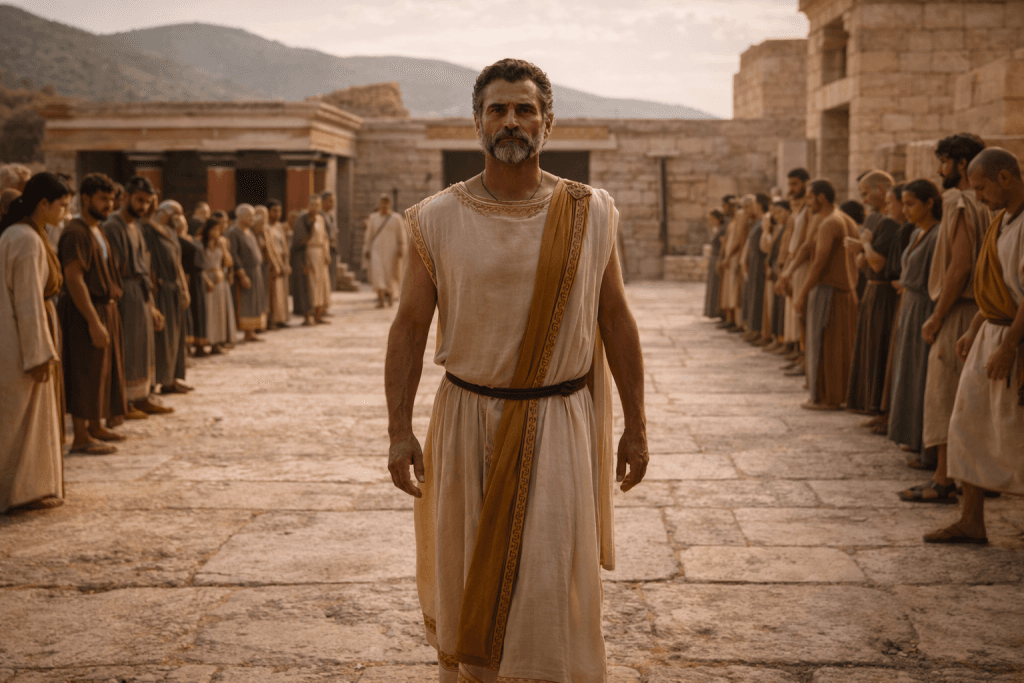
Within the wider mythological landscape of Crete, Rhadamanthys plays a subtle but essential role. He belongs to the same lineage that produces some of the most well-known stories — the Minotaur, the Labyrinth, Daedalus, Theseus. Yet he is not directly involved in those events. Instead, he exists alongside them, offering a different perspective on what leadership can look like.
Where Minos represents control, Rhadamanthys represents judgment. Where others are remembered for actions, he is remembered for decisions. This balance completes the picture of Cretan mythology. It shows that these stories are not only about conflict and spectacle, but also about order, ethics, and the structure of authority.
A Legacy Built on Balance
Rhadamanthys does not dominate the myths in the way other figures do. But he endures. His presence is steady, almost understated, yet essential. He reminds us that mythology is not only concerned with heroes and monsters, but also with the systems that hold everything together.
In a world shaped by power, ambition, and consequence, Rhadamanthys represents something quieter — and perhaps more lasting. The idea that justice, when applied consistently, becomes its own form of strength.