

Cart 0
Table of Contents
Who Was the Britomartis Goddess?
The Britomartis goddess is not one of the names most people recognize immediately. She doesn’t belong to the polished world of the Olympian gods. In fact, she feels older than that.
Her story seems to come from a time when religion in Crete was less structured, more connected to the land itself. Mountains, caves, forests — these were not just landscapes, but part of belief. Britomartis appears exactly there, somewhere between myth and place.
Her name is usually translated as “Sweet Maiden,” although that meaning probably comes from later interpretations. What matters more is where she stands in the bigger picture. The Britomartis goddess likely belongs to the deeper layer of Cretan mythology, possibly even to Minoan tradition.
So instead of seeing her as just another mythological figure, it makes more sense to think of her as a trace of something older that survived.
A Story That Moves Across the Island
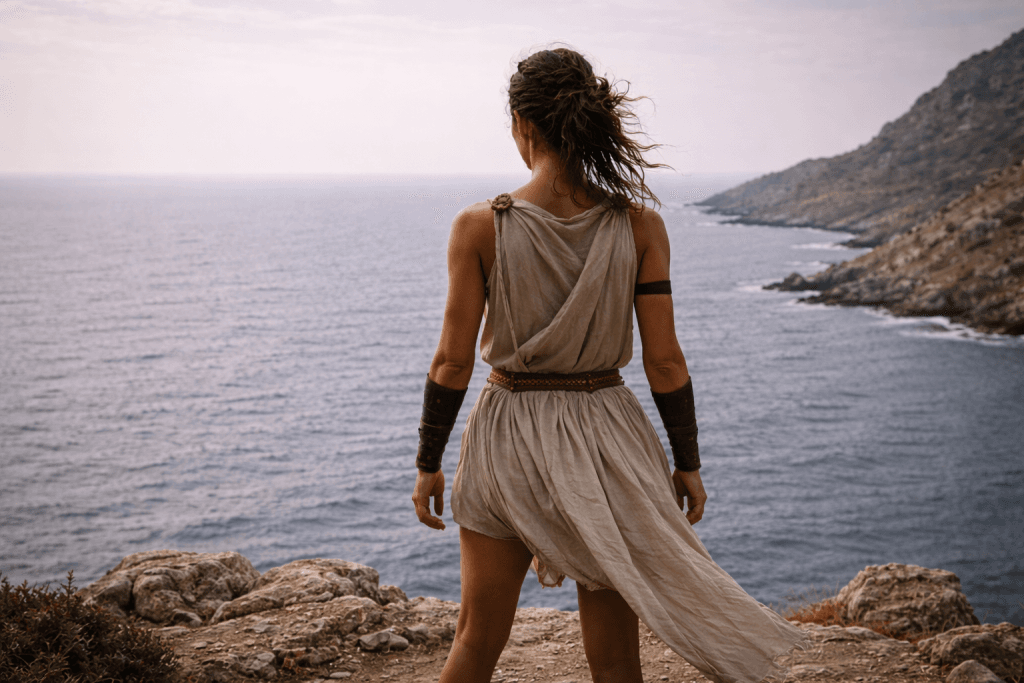
One of the main stories about the Britomartis goddess involves King Minos. As the story goes, he became fixated on her and began chasing her across Crete.
The detail that often stands out is the duration — nine months. Some see symbolism there, others simply accept it as part of myth. Either way, the focus is not really on Minos.
It is on movement.
She keeps escaping. Forests, hills, isolated places — she never stays still. There is no dramatic confrontation, no turning point where everything changes. Just a continuous refusal to be caught.
That alone gives the myth a different tone. The Britomartis goddess is not written as a passive figure. She acts, decides, avoids.
And interestingly, the presence of Minos feels almost secondary, as if the story was later adjusted to fit a more familiar narrative linked to Knossos.
The Sea, the Nets, and a New Name
At some point, the land ends. The story reaches the coast.
With no path left, the Britomartis goddess jumps into the sea. It is a sudden moment, but not necessarily a tragic one.
She survives.
Fishermen pull her out using their nets, and from that moment she is also known as Diktynna, from diktyon, meaning “net.”
This is where her identity shifts. Until then, she belongs to the mountains and wilderness. After that, she is also connected to the sea.
For Crete, this feels natural. The island has always existed between these two worlds. The Britomartis goddess simply reflects that duality.
The jump itself can be read in many ways. Escape, yes. But also transformation. Not disappearance — change.
Something That Feels Older Than the Myth
Most of what we know comes from later Greek writers. Still, many scholars suspect that the Britomartis goddess carries elements of Minoan religion.
There is no direct written evidence from that period naming her. But the patterns are there.
Minoan religion seems to have focused heavily on female figures. Not distant, abstract gods, but presences connected to nature. Mountains especially played a role, with peak sanctuaries used for rituals.
This is where Britomartis fits almost too well.
She doesn’t feel like a constructed myth. She feels like something remembered, reshaped over time, but not entirely replaced.
When Britomartis Becomes Artemis
As Greek religion expanded, older local deities were not erased. They were absorbed.
The Britomartis goddess eventually became associated with Artemis. In some places, the two were almost treated as the same figure.
This kind of blending was common. It allowed local traditions to continue without standing outside the wider Greek system.
The connection also makes sense. Both figures share similar characteristics — independence, a link to wild nature, a certain distance from human control.
Through Artemis, the Britomartis goddess did not disappear. She simply changed form again.
Why This Story Still Matters
The story of the Britomartis goddess is not as famous as others from Crete. There is no labyrinth, no monster, no dramatic hero.
And yet, it offers something different.
It points to a time before mythology became standardized. A time when belief was more fluid, more connected to landscape than to narrative.
It also highlights something else — continuity. The idea that older traditions do not vanish, but adapt.
The Britomartis goddess moves between worlds. Mountain and sea. Minoan and Greek. Myth and memory.
Maybe that is why her story feels quieter, but also more real.