
Cart 0
Table of Contents
Who Was Talos in Greek Mythology?
Some myths are built around heroes. Others around monsters.
Myth of Talos fits neither category.
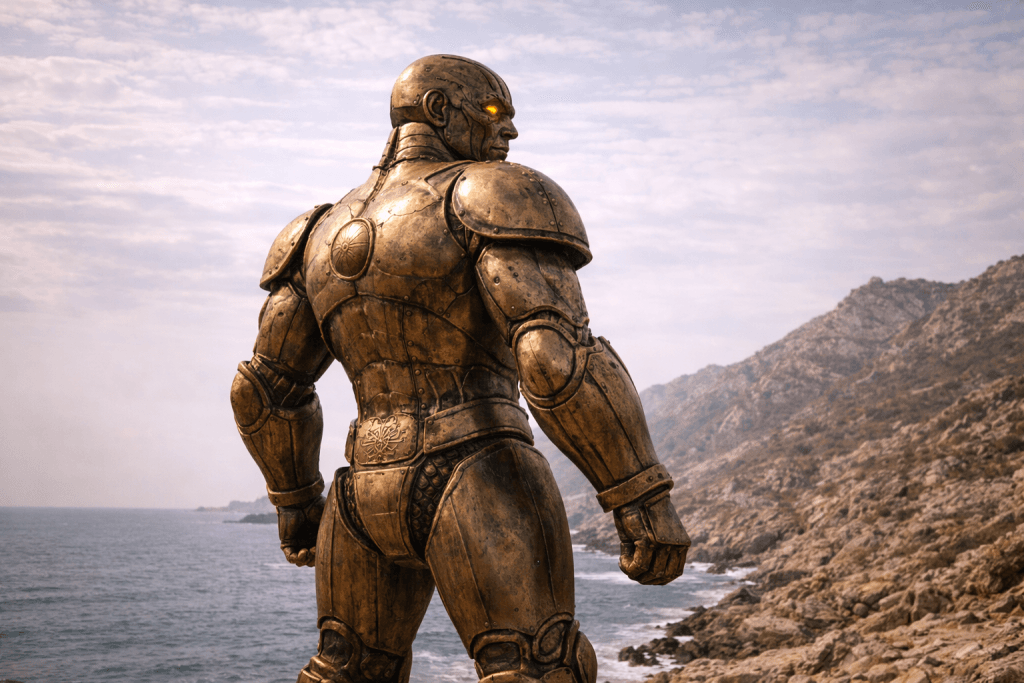
He was something entirely different — a giant made of bronze, created not to rule or destroy, but to protect. According to Greek tradition, Talos stood as the guardian of Crete. He did not live in palaces or caves. His place was the coastline.
Day after day, he circled the island, watching the horizon, ensuring that no hostile force could approach unnoticed.
That detail alone sets him apart.
He is not driven by ambition or emotion. His purpose is singular. Protection.
Myth of Talos: A Being of Metal and Divine Force
Ancient sources do not agree on how the Myth of Talos came into existence.
Some describe him as a gift from Zeus to Europa, a way of securing Crete after her arrival. Others attribute his creation to Hephaestus, the god of fire and metal, known for crafting extraordinary objects. There are even traditions that connect him to Daedalus, linking him to the broader mythological world of invention.
Despite these differences, one element remains constant.
Talos is made of bronze.
Inside his body runs a single vein, stretching from neck to ankle, filled with ichor — the substance that flows in divine beings. This vein is sealed with a metal pin. As long as it remains intact, Talos cannot be destroyed.
It is a striking image.
A creature that feels mechanical, yet is sustained by something divine. Not fully alive, but not lifeless either.
The Guardian of the Island
Myth of Talos is direct and uncompromising.
He guards Crete.
Each day, he moves along the shoreline, scanning the sea. When ships approach with hostile intent, he responds immediately. Some accounts describe him hurling enormous stones, preventing vessels from landing. Others depict a more terrifying method — heating his bronze body and destroying intruders through sheer force.
These are not random acts of violence.
They reinforce his function.
Talos is a boundary. A moving perimeter. A presence that ensures the island remains untouched.
In this sense, he reflects how Crete was perceived in myth — powerful, secure, and dominant within the Mediterranean world.
Strength Meets Strategy
His downfall comes through a familiar pattern in Greek mythology.
Strength alone is not enough.
The story unfolds during the return of Jason and the Argonauts. As their ship approaches Crete, Talos prevents them from landing. Direct confrontation proves useless. The giant is too strong, too resilient.
So the solution shifts.
Medea intervenes.
Instead of force, she uses intelligence. In different versions of the myth, she deceives, manipulates, or destabilizes him. The outcome, however, remains the same. The seal in his ankle is removed, and the ichor flows out.
Talos collapses.
The moment is quiet compared to his power. No grand battle. No heroic clash.
Just a single weakness, exposed.
What Myth of Talosn Represents
Myth of Talos is often overlooked compared to figures like the Minotaur or Icarus, yet his symbolism is remarkably rich.
At the most immediate level, he represents protection. A force that exists to defend rather than dominate.
But there is more beneath the surface.
He also reflects an early fascination with artificial life. A being constructed, yet animated. Controlled, yet powerful. Long before modern discussions about machines and intelligence, Greek mythology was already exploring the idea of something created to act independently.
There is also a political reading.
Talos can be understood as a symbol of Minoan power. Not as a literal guardian, but as a representation of naval strength and territorial control. A reminder that Crete, at its peak, was not easily approached or challenged.
And then there is the detail that defines him.
His vulnerability.
Like many figures in mythology, Talos is not invincible. His strength is absolute, but not complete. One point of failure is enough to undo everything.
Talos and the World of Crete
Unlike the Minotaur, who exists at the center of the Labyrinth, Talos stands at the edge of the island.
That distinction matters.
He does not represent internal conflict or hidden danger. He faces outward. His role is external — to guard, to observe, to respond.
This positioning reflects a different aspect of Cretan identity.
Not secrecy, but control.
Not chaos, but stability.
Within the broader mythological landscape, Talos complements the other figures connected to Crete. Where Daedalus represents intellect and invention, and Minos represents authority, Talos represents security.
A Presence That Endures
Myth of Talos does not dominate mythology with dramatic storytelling.
Yet he remains memorable.
Perhaps because he feels unexpectedly modern. A constructed being with a defined function. A guardian that operates without hesitation. A force that exists to maintain order.
His story does not revolve around emotion or transformation. It is built on purpose.
And when that purpose ends, so does he.
Still, the image remains powerful.
A bronze figure moving along the cliffs, watching the sea, standing between an island and the unknown.
Not a hero. Not a monster.
Something else entirely.