

Cart 0

Meteorite Iron Rings: How the Minoan and Mycenaean Elite Wore Metal From the Sky

More than 3,000 years ago, meteorite iron rings adorned the hands of the most powerful people in the Aegean — signet rings forged from iron that had fallen from the sky. A new study, published in 2026 in the Journal of Archaeological Science, shows for the first time with modern methods that the elites of the Minoans and Mycenaeans wore rings made of meteoritic iron, centuries before the Iron Age began. It is a discovery that throws fresh light on the world of the Cretan palaces — with Knossos at its heart — and on the power and prestige bound up with this “sky metal.”
In this article we look in detail at what the research found, where the meteorite iron rings were discovered, why the metal was so precious, where it most likely came from, and how it all connects to the Minoan tradition of signet rings that Knossos, above all, came to embody.
What the new study revealed
The study is titled “Iron in Greece in the Second Millennium B.C.E.” and grew out of a five-year, French–Greek collaboration. It was led by Matthieu Gounelle, a meteorite specialist at the National Museum of Natural History in Paris, and Eleni Mantzourani, professor of Prehistoric Archaeology at the University of Athens.
Their starting question had gone unanswered for decades: did the Minoans and Mycenaeans use meteorite iron, as other Bronze Age cultures did? And when did they first begin to work ordinary, smelted iron?
To answer it, the team spent five years on what they call a genuine “odyssey” across museums and excavations:
- 105 objects from the Bronze Age and the Early Iron Age were examined in total, of which 91 iron objects formed the core of the study — mainly rings, bracelets and knives.
- The finds come from 33 archaeological sites and are held today in 19 museums.
- They date from roughly 1800 to 1000 BC — artefacts between 3,000 and 3,800 years old.
How the finds were analysed — without any damage
Crucially, the analysis was non-destructive. The scientists used portable X-ray fluorescence (pXRF), which reads an object’s chemical make-up without harming it. That mattered, because many of these finds are far too rare and fragile to sample.
The giveaway is nickel. Iron from meteorites is naturally rich in nickel, whereas iron smelted from ore is not. So wherever the analyser picked up a strong nickel signal, the metal was very likely of “extraterrestrial” origin.
The findings in numbers
Of the 91 iron objects, 13 rings stood out for their nickel content. Of those, the signs of meteoritic origin were strong for 9, likely for one more, and inconclusive for the remaining three.
In all, about 14% of the iron objects contained nickel; the rest had none. And here is the striking part: although the sample also held tools and weapons, only rings turned out to be made of meteorite iron. That is no accident — and it is where the real story begins.
Signet rings: symbols of power in the Minoan world
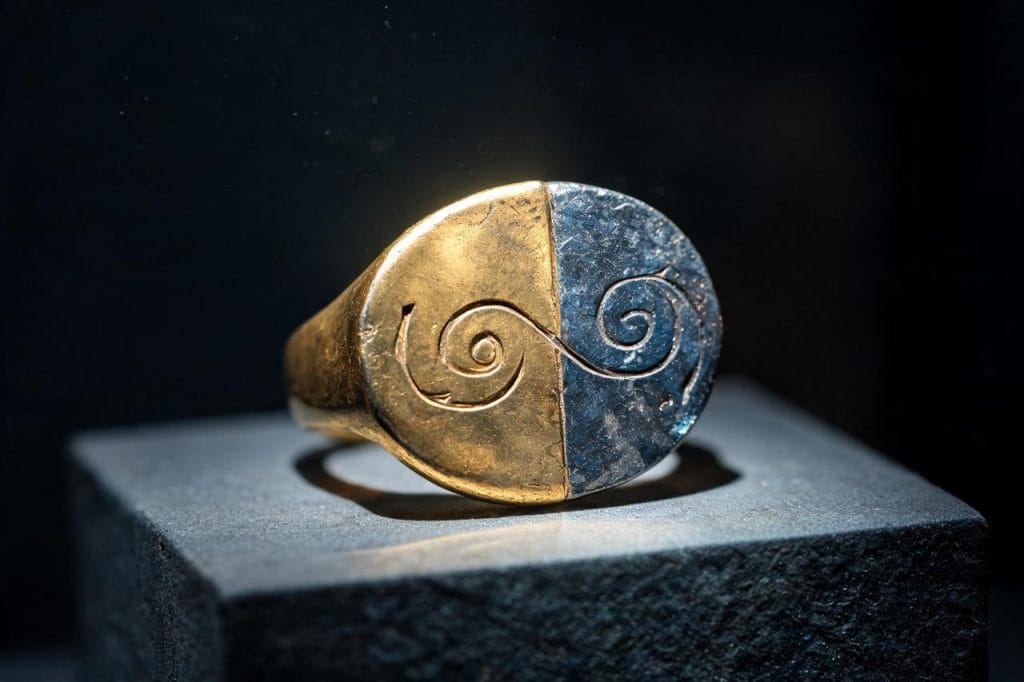
These were not simply ornaments. Most were signet rings: their flat bezel was pressed into clay to seal documents, goods and storerooms. In the Minoan and Mycenaean world, whoever held the seal held the authority behind it.
Two further details underline their prestige. First, many rings were polymetallic, combining iron with gold, silver or bronze — a deliberate pairing of the rare metal with other precious ones. Second, the craftsmanship is remarkable: two rings, from Mycenae and Phaistos, have a bezel split cleanly in two — one half gold, the other nickel-bearing iron — finely engraved by expert hands. This is a display of status, not a rough experiment.
As Mantzourani puts it, meteoritic iron was treated as a precious metal, reserved for objects of special value and for people of high standing — almost certainly the palatial elite.
Where the meteorite iron rings were found
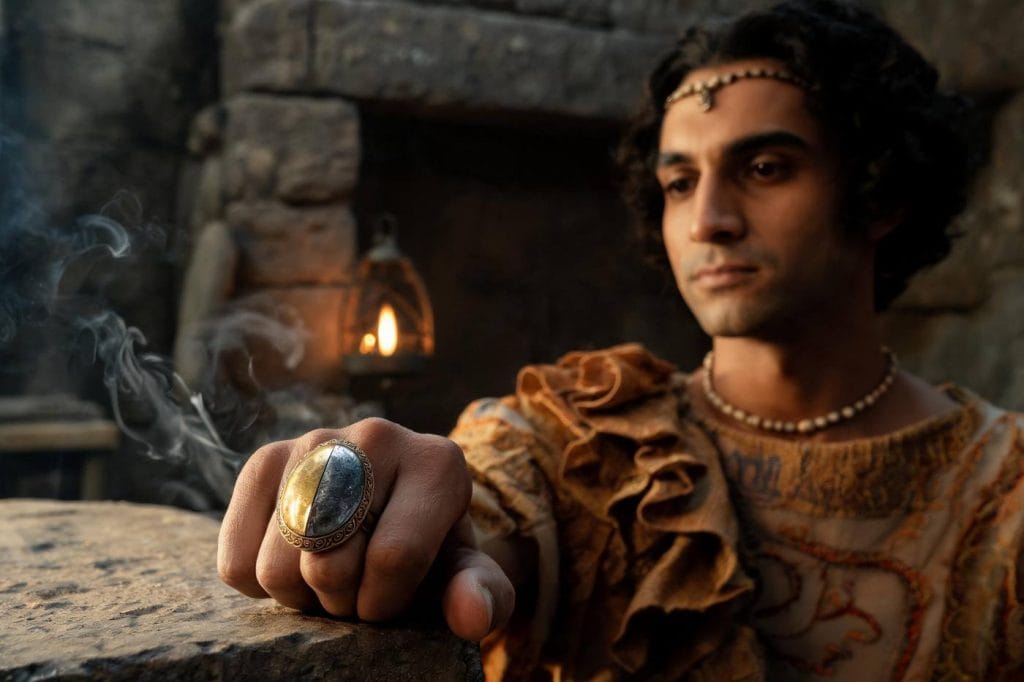
The find-spots confirm the aristocratic picture. Almost every nickel-rich ring came from tholos and chamber tombs — burial monuments built for the wealthy and powerful — alongside gold vessels, amber beads and carved seal-stones. The names read like a roll-call of Aegean prehistory: Mycenae, Vapheio, Kakovatos, Phaistos and Tiryns.
One Cretan find stands apart. The only ring not recovered from a tomb comes from the shrine at Anemospilia, on the slopes of Mount Juktas near Archanes — just a few kilometres south of Knossos. There it was found on the finger of a man the excavators read as a high-ranking priest. The image is vivid: a religious official wearing, quite literally, metal from space.
That closeness to Knossos matters. It places the discovery at the very heart of Minoan Crete and ties the “sky metal” to the sacred world around its greatest palace.
Meteorite iron and the Minoan seal tradition — the Knossos link
For anyone drawn to Knossos, this study lands close to home. The palace was the administrative and religious centre of the Minoan world — and one of the great centres of Minoan seal-carving. Seals and sealings were the paperwork of a sophisticated palace economy, recording goods and certifying who owned what.
Seen this way, meteorite iron rings are not exotic one-offs. They belong to a long Minoan tradition in which the signet ring is a personal signature of power — the same tradition that produced some of the most famous gold signet rings of antiquity. Adding a metal “from the sky” simply raises the stakes, lending the ring an almost otherworldly aura.
In short: if Knossos is the peak of Minoan art and authority, these rings are one more sign of how refined — and how symbolically charged — that society really was.
Why meteorite iron rings were so precious
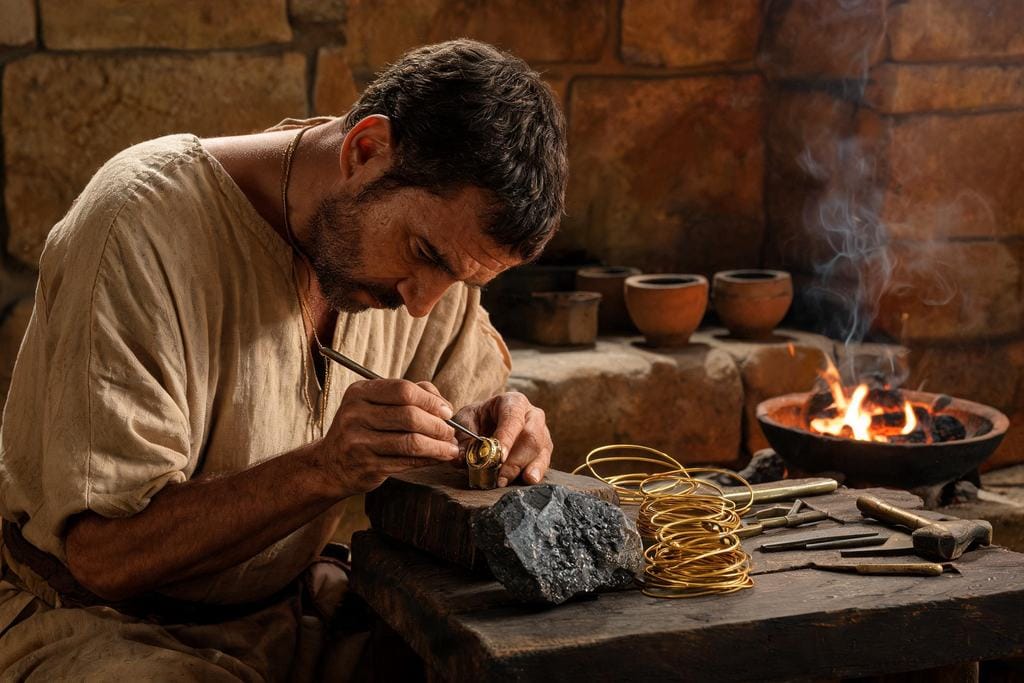
Today iron is cheap and everywhere. In the second millennium BC it was anything but. Ore-smelting had not yet spread, so the only workable “pure” iron came from iron-nickel meteorites — rare, hard to find, and therefore highly prized.
The study found a clear split in how the two kinds of iron were used in the Late Bronze Age. Meteorite iron went into fine, valuable pieces — the signet rings of the elite. Early smelted iron, by contrast, turned up in cruder, everyday objects. The craftsmen clearly saw one as precious and symbolic, the other as merely useful.
The idea of “iron from the sky” was not unique to the Aegean, either. Cultures worldwide worked meteorites: scrapers in Greenland, axe-shaped votives in China, jewels in pre-Columbian America, talismans in Egypt. The most famous example is the dagger of Tutankhamun, forged from meteoritic iron. This new study simply adds the Minoans and Mycenaeans to that map.
Where did the meteorite iron come from? The road to Egypt
So where did the raw material originate? Meteorites are rare in mainland Greece and on Crete, yet the Aegean elites clearly had a supply. The researchers point to Egypt, whose deserts preserve meteorites far better and in greater numbers. Because the trade networks of the day tied the Aegean tightly to Egypt and the eastern Mediterranean, the metal most likely travelled those long-distance routes.
If so, these rings are more than symbols of local power. They are also proof of a cosmopolitan web of exchange that, over 3,000 years ago, linked the great civilisations of the Mediterranean.
The end of a fashion: the Bronze Age collapse
The fashion did not last. Finds of this kind vanish after the 12th century BC — exactly when the Late Bronze Age collapse brought down the Mycenaean palace system. (Minoan Crete had already faded earlier, a decline often linked to volcanic and wider upheavals.)
As meteorite iron disappears, smelted iron steadily takes over, opening the way to the Iron Age. The shift may reflect economic and political turmoil, lost links with Egypt, or simply changing taste. Either way, the evidence points to a brief but intense trend — one where symbolism mattered as much as the metal.
Why this discovery matters
Beyond the appeal of “space metal,” the study carries real weight:
- It documents for the first time, with modern non-destructive methods, meteorite iron in Aegean finds — long suspected, never proven.
- It illuminates the social order of the Minoans and Mycenaeans, showing how deliberately the elite used rare materials to signal power.
- It recalibrates the Aegean’s relationship with iron, showing that smelted iron only took hold after the palaces fell.
For Crete, and for Knossos above all, the message is clear: the Minoan world was not only a centre of art and administration, but a society with access to rare, “precious” materials and a deep feel for the symbolic.
Frequently asked questions (FAQ)
What are meteorite iron rings? They are Bronze Age rings made from iron that came from iron-nickel meteorites — objects that fell to Earth from space. This “meteoritic iron” is set apart by its high nickel content, and it could be worked without smelting ore, which is why it was available long before the Iron Age.
How many meteorite iron rings were identified? Of 91 iron objects analysed, 13 rings were rich in nickel. The signs of meteoritic origin were strong for 9, likely for one more, and inconclusive for three.
Where were the rings found? At sites such as Mycenae, Vapheio, Kakovatos, Phaistos and Tiryns. The only ring found outside a tomb came from the Minoan shrine of Anemospilia, near Archanes and Knossos, on the finger of a man interpreted as a priest.
Where did the meteorite iron come from? Most likely Egypt, whose deserts preserve meteorites well; the metal reached the Aegean through the era’s trade networks.
Who carried out the study? A French–Greek team led by Matthieu Gounelle (National Museum of Natural History, Paris) and Eleni Mantzourani (University of Athens), published in 2026 in the Journal of Archaeological Science.

